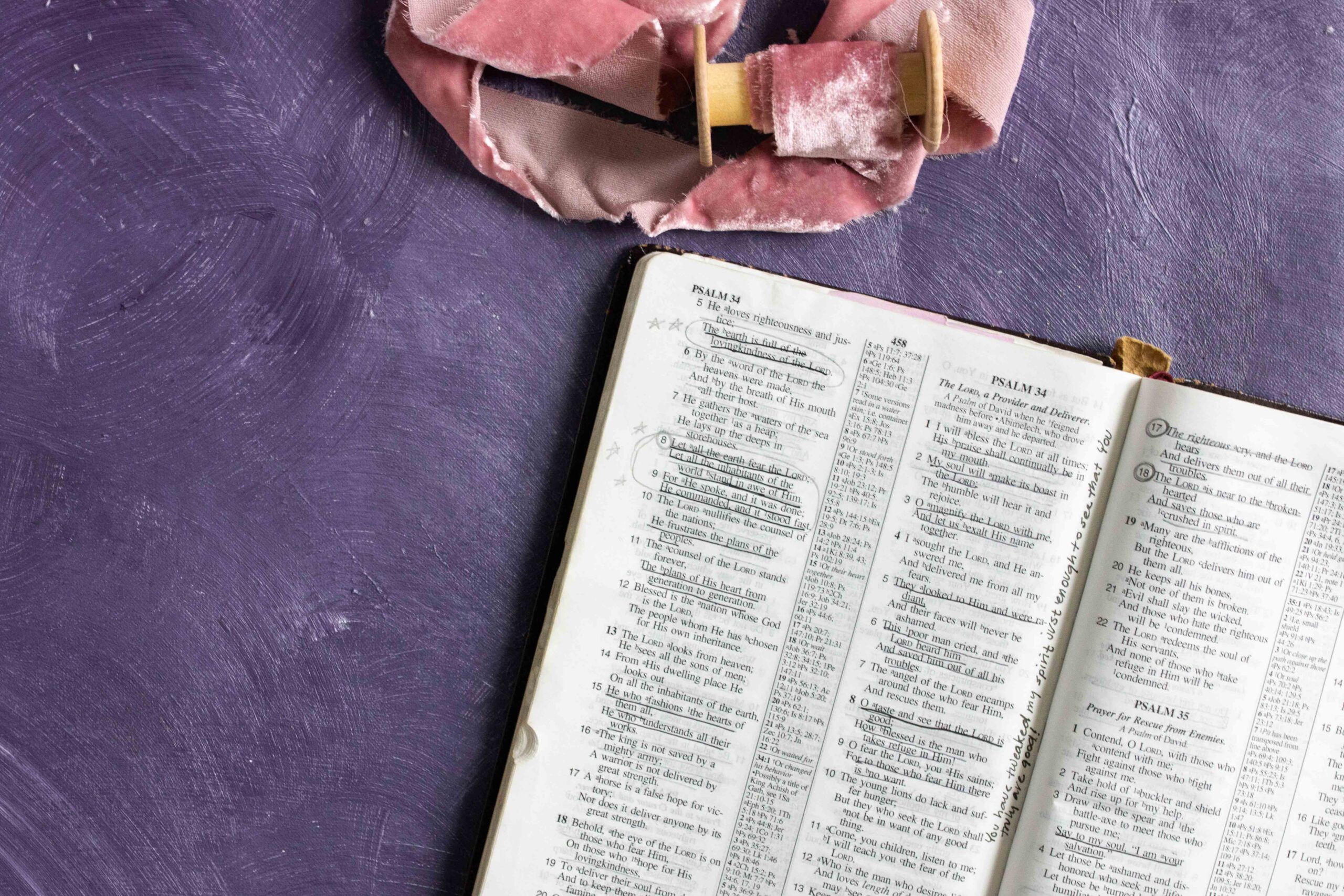
Why Philippians 4:8 Matters for Your Thought Life
The Superbowl happened last weekend, and it honestly ranks pretty high in my “Watch this event for the marketing” because rules are broken and creativity is at an all-time high. The commercials and half-time show are huge marketing stunts, and I’m spending that time analyzing every detail, guest, and costume for themessaging. It’s a wild night for visual communications.
As fun as that is 😅 I still have to remind myself—
Garbage in, garbage out.
Philippians 4:8 is one of the clearest “filters” God gives us for what we allow to take up space in our minds—because what we repeatedly focus on shapes what we feel, believe, and do.
Finally, brothers and sisters, whatever is true, whatever is noble,
whatever is right, whatever is pure, whatever is lovely, whatever is
admirable—if anything is excellent or praiseworthy—think about
such things.
How to Redirect Your Mind When You’re Overwhelmed
“LOL COOL, RACHEL, FOR TELLING ME THE SKY IS BLUE.”
But really, this concept isn’t new, and apparently, I (we) do need areminder every few centuries about it… John Piper wrote “Direct yourmind away from the hurt… Direct it to what is true and beautiful and pure and lovely and praiseworthy,” and he got that idea from Philippians 4:8.
This kind of redirection isn’t denial. It’s discipline. It’s practicing what you’ll do with your attention when life hands you content, conflict, or stress on a silver platter.
What You Consume Shapes Your Thoughts (Garbage In, Garbage Out)
If you see it, you’ll think it. If you THINK it, you’ll BECOME it.
It can be a slow process, but it always happens.
This is why Scripture talks so often about the mind: not because God is trying to micromanage you, but because He’s protecting you from patterns that steal peace.
Why True Crime and Dark Content Can Affect Your Mental Health
I had to take a break from the true crime podcasts because… it was getting way too dark, and I was mentally going to a hopeless place. I started viewing events and people through a pessimistic lens instead of giving them the benefit of the doubt. And when I did experience something happy? It was stifled—maybe 40% of what it should have been because my mental state was filled with crime scene descriptions, stories of broken relationships, and just plain bad news.
If you’ve ever felt your “baseline” shift darker after what you’ve been watching or listening to, you’re not imagining it. That’s your mind doing exactly what minds do: rehearsing what you feed it.
How to Stop Overthinking by “Flowcharting” Your Thoughts
So how do we remember good when we’re bombarded with reminders of evil’s presence in our world?
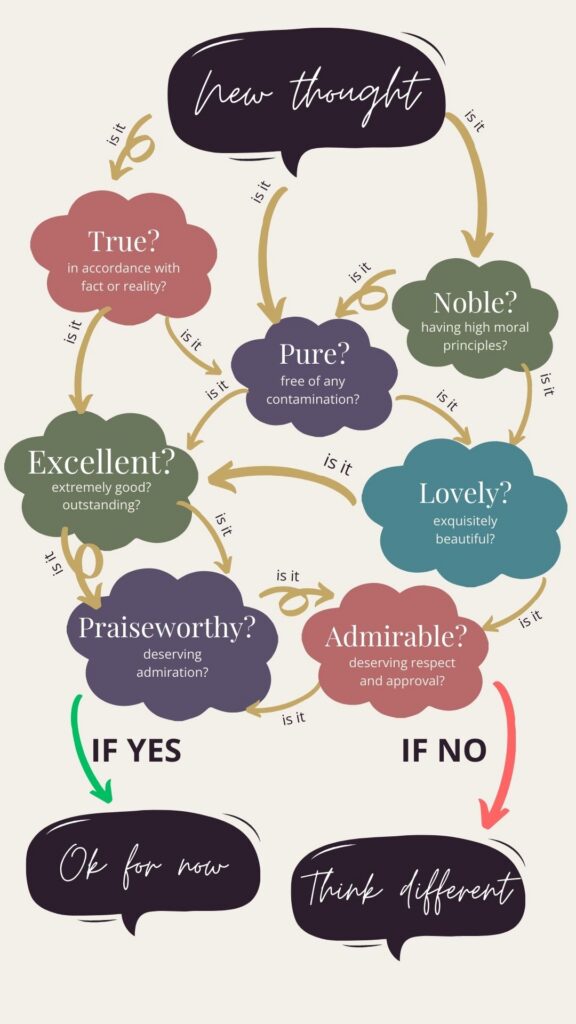
This has been my go-to process: Flowchart your thoughts according to Philippians 4:8.
- Is me dwelling on an argument, thinking of rebuttals, and “winning” true? No, because it already happened. It’s done, and I can’t revisit the past and change it… so not worthy of my time.
- Is this podcast of gossip, name-calling, “theories,” and raigebait lovely? Nopesies. Quite the opposite. Not something I should give attention to.
- Is this mental replay of past mistakes which leads to shame-piling something that would bring God praise? Maybe? But most likely not if I’m just wallowing in embarrassment andcausing myself to become paralyzed instead of moving forward in forgiveness.
This is the power of a “flowchart” framework: it slows the spiral down long enough for you to tell the truth about what the thought is producing in you.
What to Do When Anxiety Keeps You Awake at Night
I do get it, thoughthe thought comes, attention is given to it, and then what do you know you can’t sleep because your brain is actively giving energy to something that isn’t Philippians 4:8-approved.
If nighttime is when your brain gets loud, it helps to have a plan ready before the spiral starts—something simple you can repeat when you don’t have the energy to “figure it out” at 2 a.m.
A Simple 5-Step Biblical Practice to Take Thoughts Captive
It takes a lot of discipline and practice, but you can control your thoughts.
The next time a memory or thought 💭 ~~appears~~ 💭
- Take a breath
- Ask yourself “Is this something I would give to God?” (And
maybe really imagine it—imagine yourself wrapping up that
thought in a little box, tying a ribbon on it, writing “To: God” on
the card, and holding it out) - If no, move on. Replace the thought. Think of a different
memory. Recall a verse. Pray “God give me _____.” Anything else. - If yes, give it a couple more minutes of your time. Express
gratitude to God, text a friend, write it down. - Take a breath
The key phrase in this process is: Replace the thought. It’s not just “stop thinking.” It’s choosing what you’ll think instead—truth, prayer, Scripture, gratitude, or a different memory.
How to Guard Your Mind Without Routine
Depending on your schedule (and when you read this post), you might have a weekend ahead of you—potentially, a break in the “routine” and normal schedule—which means there’s ample opportunity for our brains to fizzle out and betray us.
But, Christian, please remember that you’re stronger than you give yourself credit—you have the armor of God (Ephesians 6) and the Holy Spirit. What can really stand against those… and win?
Weekends can be sneaky because they loosen structure. That’s why having a simple mind-filter (Philippians 4:8) and a simple plan (your 5 steps) is so powerful.
Bible Verses for Anxiety, Hope, and Feeling Forgotten
And some extra help if you need it:
- Verses about God’s sovereignty
- Verses about hope
- Verses about contentment
- Verses to combat anxiety
- Verses about patience
- Verses for when you feel forgotten
If you’re building a “replacement list,” start with one category you need most right now, and keep it where you’ll actually use it (nightstand, phone lock screen, car dash, bathroom mirror).